What did American Express publish on October 6, 2026?
A free playbook for selling through AI agents, and the survey data underneath it. Amex had Teneo poll two groups in August: 2,005 US adults who each made three or more online purchases in the prior six months, and 502 US business leaders who own payment options or online sales at their companies. The consumer numbers are the ones I would print and tape to a wall.
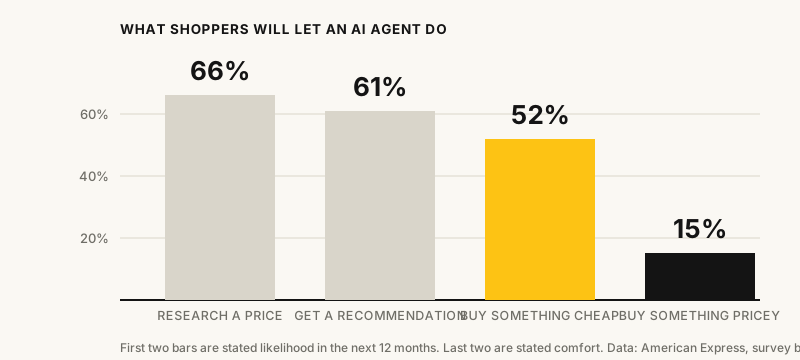
Here they are. 66% say they are likely to use an AI agent to research the best price on something in the next 12 months. 61% would use one for product recommendations. Then the line moves. 52% are comfortable letting an agent actually buy everyday, low-cost things, the household essentials and the groceries. For high-value items, the electronics and the appliances, that drops to 15%.
So shoppers will hand an agent the shopping list and keep the credit card. I think that is the most useful fact in marketing right now, and what it measures is trust rather than technology. Research moved to agents first because research is cheap to be wrong about. If the agent picks a bad brand of paper towels you are out four dollars and a mild annoyance. If it picks the wrong dishwasher you are out six hundred dollars and a Saturday.
Mostly not, by their own account. Only 41% of those 502 business leaders say they are actively experimenting with or implementing agentic commerce. And 86% expect they will need at least moderate help from payment providers and partners to pull it off. Read those two together and you get a market that knows something is coming and has not staffed for it.
Anna Marrs, who runs Global Merchant & Network Services at Amex, called agentic commerce possibly “the most significant change in shopping and purchasing behavior” since e-commerce began. Executives say things like that at product launches, so I weighted it lightly. What I did not weight lightly was the chapter list. One chapter is titled “Stand Out When AI Narrows the Choices,” and that is the actual job now. The agent builds a short list before any human sees your name.
I have watched this shape before from the other side of a counter. Online shopping took years to go from browsing to buying, and the brands that won spent those years fixing boring things. Accurate prices, mostly, and stock counts that were actually true. Same work in front of us now, with a different reader. The reader is a machine, and it is far less forgiving about a missing field than a person is.
What it means Sort your catalog by price and treat the two piles as different jobs. Under about $50, an agent may buy it, so the page needs facts a machine can read without guessing: price, size, availability, return window, in structured data. Over that line, the agent only recommends, so the page has to win a human who shows up with a short list already in hand. Same catalog, two jobs, and almost nobody has split them yet.
66%of surveyed consumers say they are likely to use an AI agent to research the best price in the next 12 months
15%are comfortable letting an agent buy high-value items, against 52% for everyday low-cost goods
41%of the 502 surveyed business leaders are actively experimenting with or implementing agentic commerce
The Interface Changed
ChatGPT started answering with buttons instead of paragraphs
On October 7 OpenAI began rolling out GPT-6 to everyone, and with it a capability called Intelligent UI. OpenAI describes it as letting ChatGPT “answer quickly with fully interactive user interfaces”, and says a single reply can now carry “graphics, tappable buttons, forms, charts, and interactive experiences.” Paid tiers got it that day on GPT-6 Sol. Free and Go followed the next day on GPT-6 Luna.
One thing worth saying plainly, because I have seen it written the other way this week. OpenAI's post does not pitch this as a shopping or product-comparison feature. Its examples are a savings calculator, a bill splitter, a statistics explainer. The commerce read below is mine, not theirs.
What it means The answer page is turning into an app. When your category gets explained inside a little interactive widget, the facts in that widget come from somewhere, and you want them coming from you. Ask ChatGPT about your category this week, logged out, and screenshot what comes back. That screenshot is your new above-the-fold.
Consumer sentiment just fell for a third straight month
The University of Michigan's index of consumer sentiment reads 48.1 for September, after 51.7 in August and 55.2 in July. On prices, the most recent Consumer Price Index report from the Bureau of Labor Statistics put all items up 3.4% over the year, with core up 2.4%. The October preliminary reading is due this morning.
What it means Your shopper is cautious, and the agent in the story above is being handed the cheap end of the basket. Those two facts point the same direction. Under-$50 work is not a side project this quarter. It is where the volume is.
Global ad spend is heading to $1.34 trillion, and three companies hold most of it
WARC Media's October 8 forecast has worldwide advertising up 11.9% this year to $1.34 trillion. Alphabet, Amazon and Meta together take 59.7% of that outside China, which WARC puts at $659.6 billion. Social is the fastest grower at 21.3%, reaching $394.6 billion. Retail media is up 14.3% to $202.1 billion. Suzy Young, who heads WARC Media Data, summed the year up this way: “These are unusual times for advertising.” WARC credits corporate AI spending plus the Olympics, the World Cup and the US mid-terms.
What it means Before your next planning meeting, add up what share of your media budget goes to those three companies. If you land near 60% you are simply average, which is worth knowing out loud. The better question is what the other 40% buys you that they cannot.
Claude Haiku 5.5 arrived October 7 at $0.10 per million input tokens and $0.50 per million output, for prompts up to 100,000 tokens. Above that it is $0.50 and $2.50. Haiku 4.5 was $1.00 and $5.00. Anthropic's own line is that “on average, it now costs around 75% less to run,” and the footnote does the work: 90% cheaper under 100,000 tokens, 50% cheaper above it, with 90% of the old model's requests sitting in the cheaper band. The updated tokenizer does use slightly more tokens per task, and Anthropic says those savings figures already account for that.
What it means Pick one repetitive writing job you turned down on cost. Product descriptions, alt text, first-pass subject lines. Price it again this week. A tenfold cut on the small model changes which jobs are worth automating, and whatever you concluded six months ago is stale.
Typeform will build you a landing page in a conversation, and measure it later
On October 6 Typeform shipped AI Landing Pages to all users. You describe the page, refine it by chatting, add your own SEO metadata, and publish on your own domain. It will attach a form, a product catalog and a linked checkout, and it connects out to Canva, Notion, Shopify, Slack and Stripe. Aleks Bass, Typeform's Chief Product and Technology Officer, says the builder “collapses that into one conversation.” Built-in analytics for visitors, traffic sources and bounce rate are listed as coming soon.
What it means Building the page stopped being the hard part. Reading the result is. If you try this, put your own analytics on the page before you publish, because a tool that makes ten variants cheap and measurement late is a tool that will happily teach you nothing.
Three moves. The first one is a spreadsheet and an afternoon.
1 · MondaySort your catalog into two piles at about $50. Under the line an agent may buy it, so the page needs machine-readable facts: price, size, stock, return window. Over the line an agent only recommends it, so the page has to win a human who arrived with a short list already made.
2 · This weekAsk ChatGPT about your category in the new interactive interface and screenshot what it shows. Do it logged out. Whatever facts land in that widget are the ones your next shopper starts from, and you did not write them.
3 · Before the next issueTake one repeating content job you priced out as too expensive and price it again on a small model. Haiku 5.5 is a tenth of what it was. Bring the real number back, not the estimate.
The thread running through all of it Last issue the thread was the price tag, whether the number a shopper sees is the number they pay. This week it is the price ceiling, how much money a person will let software spend without being asked first. Both are the same question wearing different clothes. How much of the buying decision are you willing to hand over, and what do you need from a brand before you do it?
Agents will buy your cheap things first. Subscribe and I will send you the checklist version of the Playbook, plus the next issue when it is out.
Watch List & Sources
What I'm tracking into next week
01The October preliminary sentiment reading, due this morning. September came in at 48.1 after 51.7 and 55.2. A fourth straight decline would make the cautious-shopper story the whole fourth quarter rather than a wobble. University of Michigan
02Whether Amex's 41% moves. That is the share of surveyed businesses working on agentic commerce in August. If it is still near 41% next spring, the window in the lead story was real and most people slept through it. American Express
03Whether Intelligent UI grows a commerce surface. OpenAI did not announce one. It also did not need to. A tappable comparison widget is one product decision away from being a storefront. OpenAI
04Typeform's analytics add-on. It is the missing half of the product. Until it ships, anyone running variants on that builder is guessing with extra steps. Typeform
05The next CPI print. All items sat at 3.4% in the most recent report. Whether that holds decides how much of the under-$50 basket is a price decision rather than a convenience one. U.S. Bureau of Labor Statistics
06Whether the 59.7% keeps climbing. Alphabet, Amazon and Meta hold almost six dollars in ten outside China. I would like to know the number where media planning stops being planning. WARC Media
Every claim above traces to a primary source, and each story carries its own sources rather than pooling them. Where a figure is a company's own number, the copy says so. Two things were cut from this issue for failing that test: a widely repeated survey of 16,000 shoppers I could not verify at the publisher, and a retailer-versus-agent story that existed only in secondhand coverage. Past issues live in the AI in Marketing Weekly archive, the show is on the AI in Marketing Daily podcast page, and the questions readers ask most are answered in the FAQ.
Before any of this, I spent seven years at Kroger in store operations. That is where I learned retail, from the floor, watching people decide things with a cart in front of them.
Here is what sticks with me from those years. People do not hand over trust all at once. They hand over a little, watch what you do with it, and then hand over a bit more. A shopper who has never bought your brand picks up the small size. The one who has bought it for a decade buys the case.
That is what 52% and 15% are. Somebody turned the oldest behavior in retail into two numbers in a spreadsheet, and the numbers say shoppers are running the same test on AI agents that they have always run on brands. Start small. See what happens. Nobody has to be taught to be careful with six hundred dollars.
I find that encouraging, and I know the trade press is reading it as a ceiling. Look at what the 15% actually protects. The expensive, infrequent, nervous-making purchase is still a decision a person wants to make, and that is the one where a brand has ever really mattered. Agents did not take the relationship. They took the errand. Honestly, good. The errand was never the interesting part.
The catch is that the errand is where you earn the rest. A brand that is accurate, in stock and straight about its return policy when an agent is buying four dollars of paper towels is a brand that gets considered when the same household needs a refrigerator. Get the small size right and you get asked about the case.
Pro Humanitate is Wake Forest's motto. For humanity. I use this space each week to ask who the week was actually good for, and this one is good for the shopper. They got a tireless assistant for the boring purchases and they kept the decisions that matter. Our job is to be worth trusting at both sizes.
Human-centered AI in marketing. What actually shipped, and what to do about it Monday. Free, from Wake Forest University's School of Professional Studies.