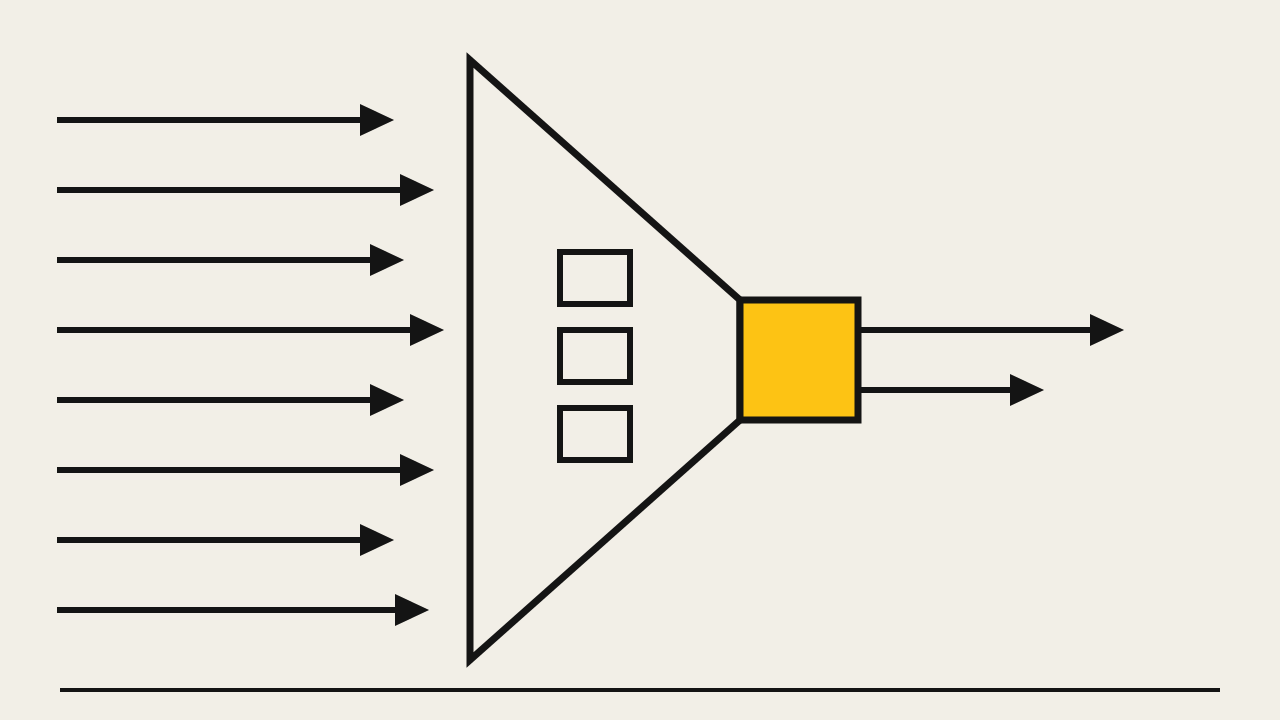
Marketing bought a faster engine for a car stuck in traffic.
Seven in ten enterprise marketing teams run AI in production. Eighty-eight percent still have to fix what it writes, and 85% missed a campaign launch date anyway.
Seventy percent of teams pointed AI at the wide end. The narrow end never moved. Illustration: AI in Marketing Weekly
Knak published Marketing Production in the Age of AI on Tuesday, built on 300-plus enterprise marketing leaders at companies including Google, Amazon, Uber, and Meta. Seventy percent have AI running in production. Eighty-eight percent say the output still needs real human editing. Eighty-five percent missed at least one launch date last year.
Here's the part I'd underline for a CMO. When Knak asked why launches slipped, nobody said "we couldn't write the copy." They said approvals and sign-off (47%), design and creative production (38%), cross-team coordination (36%). All three are people waiting on people. Now look at where the AI got pointed: 64% use it for first-draft copy, 56% for images, and only 25% aim it at building and coding the emails and landing pages, the step that eats the most calendar. We automated the cheap hour and left the expensive week alone.
The cost is countable. One email pulls in four or more people at 60% of these companies and crosses three to five tools at 54%. That's north of $300 in internal labor per send, by Knak's math. Half still approve through a Slack thread. That isn't an AI problem. It's an org-chart problem wearing an AI costume, and you can fix it this quarter without buying a thing.
What it means Measure your AI by launches shipped on time, not drafts produced. Those two numbers move independently, and only one of them is on your calendar.
70%run AI in production today
88%still edit what it writes
85%missed a launch date anyway
E-Commerce & CX
Algolia puts a meter on the agent
Algolia shipped guardrails and cost controls into Agent Studio on Tuesday: per-IP request limits, max tokens per response, conversation-depth caps. Read the feature list backward and you can see the failure it was built for: an agent that answers beautifully and burns unbounded spend doing it.
What it means Put a token budget next to your conversion target before you sign the next agent contract.
Retail Media
WPP hands pricing to the machine
WPP Media partnered with Kily on Tuesday to run agentic commerce across India's marketplaces. Kily's agents manage listing, pricing, and ad decisions on their own, wired into WPP Open. Handing pricing to software moves margin control out of a meeting and into a model.
What it means Agent behavior just became a P&L line, not a productivity feature. Ask finance who reviews an agent-set price, and how fast a bad one comes down.
WARC and TikTok surveyed 400 marketers across four countries and landed somewhere worth taping to a wall: relevance beats volume, and a model can't fully copy relevance. TikTok's Andy Yang said the brands winning aren't making the most content. They're learning fastest from the people they serve. Everyone can make fifty posts a week now. That's exactly why fifty posts is worth nothing.
What it means Use AI for the draft and the cleanup. Keep the judgment human.
Brand & Agency
StackAdapt's Ivy Studio finds the top 20
StackAdapt shipped Ivy Studio on Tuesday, a workspace where a marketer states an outcome in plain language and agents, grounded in the platform's own campaign data, come back with a recommended next step. The number I keep circling: StackAdapt's own staff run more than 15,000 AI-assisted workflows a week, and nearly 70% of Ivy Studio usage lands inside the top 20 workflows. Note what they didn't do, either. Approval stayed with the operator.
What it means Agent value concentrates hard in a handful of things people already do over and over. Find your own top 20, automate those, leave sign-off with a human you can name.
What it means The customer your agent is selling to caught a small break. Price and message like it's temporary, because it is.
The Marketer's Playbook
What To Do Monday Morning
Three moves, in order, with dates attached. None of them require buying anything.
1 · By FridayAudit your production layer before buying another generation tool. Count the people, tools, and revision rounds behind one email, then price the hours.
2 · By month endAdd token ceilings and request limits to your agent buying checklist. Any vendor worth signing answers "what does this cost at scale" without flinching.
3 · Before launchName the person who approves an agent's decision. One human, per agent, in writing, plus the escalation path and the error rate you'll live with.
$300+Internal labor cost of a single enterprise email send, by Knak's math. That's the number your production audit is hunting.
What it means Your bottleneck is sitting in an approval queue, not a text box. Every one of these moves attacks the queue.
Watch List & Sources
What I'm tracking into next week
01The final July Michigan reading. Does 54.4 hold, or fade the way May's did? Surveys of Consumers
02BLS CPI for July, Wednesday, August 12. Energy drove June's 0.4% monthly drop, the largest since April 2020. That tailwind won't repeat.
03Whether a US holding company copies the WPP–Kily model. Agent-run pricing gets tested in India first, then travels.
Every claim above traces to a first-hand source. Links go to the original, not to coverage of it.
The Slow Part of the Work Was Always the Human Part
Read this week's numbers again and notice what they're actually describing. Approvals. Design production. Getting four people to agree. Every one of the three bottlenecks marketers named is a place where a person has to decide something in front of other people. We spent two years automating the fast part and the slow part didn't move, because the slow part was never a typing problem.
That's not a failure. That's a finding. McKinsey.org's read on the skills that matter in an AI-driven workplace lands in the same place from the other direction: judgment, creativity, and the willingness to sit with a hard question gain value at exactly the rate the routine work disappears. TikTok's Andy Yang said the winning brands aren't making the most content, they're learning fastest from the people they serve. Learning from people is not a workflow you can buy.
Wake Forest's motto is Pro Humanitate, for humanity. I teach under it, and this week's data made its case without meaning to. The bottleneck in modern marketing turns out to be the part of the job that requires a person to take responsibility in front of other people. Machines got faster at everything around it. The job at the center got more valuable, not less.
Human-centered AI in marketing — what actually shipped, and what to do about it Monday. Free, from Wake Forest University's School of Professional Studies.