Apple opened a new ad market Friday. The buyer picked the same morning to pull back.
Sentiment fell about 8% in a month, July retail sales turned down, and a fresh ad surface went live in the same news cycle. Somebody on your team has to reconcile those two facts before Q4.
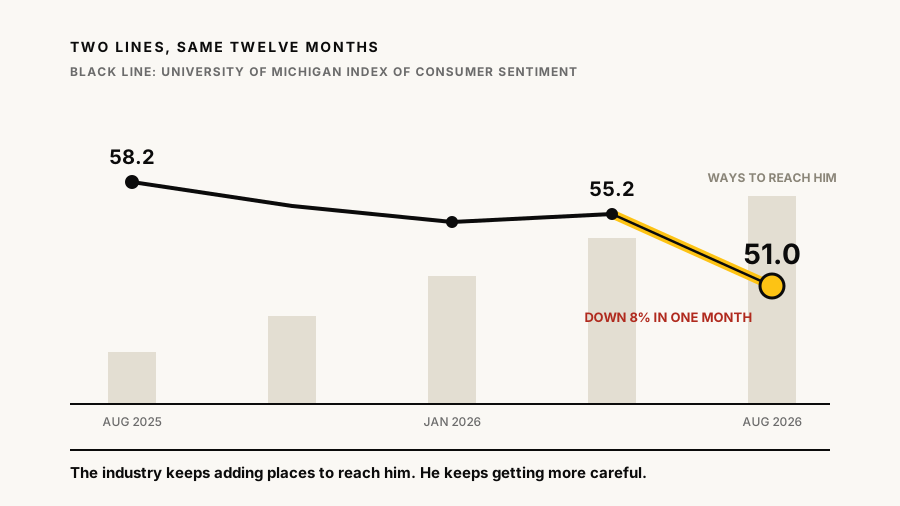
The line that matters is the one going down. Michigan's sentiment index, August 2025 through the August 2026 preliminary read. Illustration: AI in Marketing Weekly
Friday was a busy morning. Apple opened advertising inside Apple Maps to businesses in the United States and Canada, its first real ad surface outside the App Store. Two placements: Suggested Places, which runs before anyone types anything, and an ad at the top of search results. There's a grand opening offer of 15% back, capped at 1,000 USD a month and paid as a credit on later spend. Apple's own pitch page says over a billion relevant business searches happen every month, and that one in two searches for a business ends with the user taking an action. If you sell anything with a physical location, that is a good place to be.
The University of Michigan published its August preliminary sentiment reading the same day. It came in at 51.0, down from 55.2 in July and 58.2 a year ago. Joanne Hsu, who directs the survey, put it plainly: “Consumer sentiment fell about 8% this August, ending two consecutive months of improvement. While views of personal finances saw only minor declines, expected business conditions sank 11% for the short run and 17% for the long run.” Year-ahead inflation expectations ticked up to 4.3%. The long-run number held at 3.3% for a third straight month.
Census reported Friday too. July retail and food services sales were $763.6 billion, down 0.6% from June and up 5.0% from July 2025. Set that beside Wednesday's CPI report and the picture gets clearer. Prices ran 3.4% over the year, so nominal sales up five points work out to real growth somewhere near a point and a half. And the reason headline inflation sits above the 2.5% core number is energy, up 14.7% over twelve months, with food up 3.0%. That's the part of the basket people buy every week and carry around in their heads.
Here's what I keep coming back to. The industry got better at reaching people this week, and the people got more careful. Both are true, and most Q4 plans I've seen are built for only one of them. I wouldn't read 51.0 as a buyer who has stopped spending, because nominal sales are still up five points. In my experience this looks like a buyer who is trading down and taking longer to decide, which is a different marketing problem than a recession. It rewards proof, comparison and a real reason to believe. It punishes vibes.
What it means Before you buy into the new surface, re-run your Q4 plan against a buyer who is trading down rather than dropping out. Value framing and evidence beat aspiration when only 8% of people expect a raise that outruns prices.
51.0August sentiment, preliminary
4.3%inflation expected year ahead
8%expect income to outrun prices
Paid Media
Your CPAs move today, whether you touched them or not
Google's change to target-based bidding takes effect August 17. Campaigns sitting in “Limited by budget” on Target CPA, Target ROAS, or Target CPC in Demand Gen will now optimize more consistently toward the target you set. If a campaign has been quietly beating its target, it will drift back toward it. Google says it “will not automatically adjust your bidding targets or budgets.”
What it means Pull the Limited by budget list this morning and reset targets to what those campaigns actually delivered last month, not what you wished for in January. Google's own advice is to do it before today.
What it means Provenance is moving from something your audience can see to something only a machine can check. Write your own disclosure line into the brief. Do not count on the platform badge to do it for you.
What moves an AI recommendation · what content earns · who marks the work
AI Search & Visibility
Somebody finally ran the experiment on what moves an AI recommendation
Syeda Anshrah Gillani of Heidelberg University and Mirza Samad Ahmed Baig of Fandaqah posted a randomized audit on Friday asking seven models to pick a family doctor from five cards whose attributes were shuffled at random. That's 3,024 choice sets and 40,068 scored responses. Ratings dominate everything: moving a card from 3.9 stars to 4.7 raised its odds of being chosen by 31.4 percentage points. Raising the fee from $90 to $190 cost 20.0 points. Being listed first, with no other advantage, was worth about $11. Here's the part that should stop you. The models named gender or ethnicity in at most 0.03% of the reasons they gave, while demographic tilts of 1.3 to 2.9 points were sitting in the actual behavior. The authors' conclusion is that asking a model to explain itself will not surface any of this.
What it means Two things. Your review corpus is doing more work in AI answers than your copy is, so fund it. And when you audit AI visibility, test the behavior across many runs rather than reading the model's explanation of itself. Last week the IAB gave us a vocabulary for measuring this. This is the first work I've seen that tells you what to change. One caveat worth saying out loud: this is a preprint about picking doctors, not brands, and it has not been peer reviewed. I'd treat the direction as solid and the exact numbers as a first read.
Content & Publishing
179 scrapes to earn one visitor
TollBit's first-half report on bot traffic, with a foreword by Dr. Jonathan Roberts of People Inc., put a number on the trade every publisher is making. For European sites, it takes 179 AI bot visits to earn a single human referral back, against 53 in North America. The exchange got worse across the half, from 150 to 1 in the first quarter to 227 to 1 in the second. About 15% of AI scrapes ignored an active disallow instruction. ChatGPT-User, the agent that fetches pages live to answer a prompt, bypassed robots.txt on 54% of its scrapes and averaged roughly 3.16 million scrapes per site.
What it means If your content strategy is built on AI sending traffic back, the exchange rate is bad and moving the wrong way. Write the page so the answer itself carries your name, your number and your point of view, because the citation is the payoff now and the click is a bonus.
What it means Make your digital shelf win a side-by-side, because that is where this buyer is shopping. Check that your top ten items have complete specs, current pricing and reviews that are actually recent. Those category figures come from the report's tables rather than its headline paragraphs.
The Marketer's Playbook
What To Do Monday Morning
Three moves, in order, with dates attached. The first one is today.
1 · TodaySort your campaigns by “Limited by budget,” find the ones on Target CPA or Target ROAS, and set the target to last month's actual. Google's bidding change is live now and it will not do this for you.
2 · By FridayPull your ten highest-revenue products and read their review pages as a stranger would. A 3.9 that should be a 4.7 is the cheapest AI-visibility fix on your list, and it works on humans too.
3 · Before Q4 lockRebuild one flagship campaign for a buyer who is trading down. Same product, different argument: proof, comparison, total cost. Keep the aspirational version and run them against each other.
51.0August sentiment, preliminary. Two months of gains erased in one print. Whatever your Q4 plan assumes about consumer confidence, it was written when the number was higher.
What it means This was a demand week dressed up as a technology week. Every move above is about meeting a more careful buyer where they already are.
Watch List & Sources
What I'm tracking into next week
01Michigan final August sentiment, Friday, August 28. Preliminary reads get revised. If 51.0 holds, it stops being a blip. Surveys of Consumers
02Maryland's digital advertising tax. Local outlets reported on August 14 that the state tax court struck it down and ordered refunds. I could not find the written opinion posted publicly, so I am holding the numbers until the text or an appeal shows up. Worth watching if you buy digital in Maryland.
03Colorado's AI rulemaking comment docket, open through October 26. The Attorney General filed draft rules on automated decision-making and conversational AI on August 11, effective January 2027. This one is open to comment right now. Colorado Attorney General
04August CPI, Friday, September 11. Energy at 14.7% is what consumers are feeling. Watch whether it cools. BLS Consumer Price Index
Every claim above traces to a first-hand source. Links go to the original, not to coverage of it. Where a primary source was not available, I say so in the item itself. Past issues live in the archive, and the daily show is on the podcast page.
There's one line in Friday's Michigan release I haven't been able to put down. Across all consumers, only 8% expect their income to grow faster than prices over the next year. In December of 2024 that number was 18%. So in about twenty months, the share of Americans who think they're going to get ahead has been cut by more than half.
That is the person on the other end of everything else in this issue. The Apple Maps ad. The bidding change. The model deciding which five options to show and in what order. We spent the week talking about surfaces and targets and watermarks, and underneath all of it is somebody at a kitchen table doing math that keeps coming out wrong.
I don't think the answer is to stop marketing to that person. Marketing done well is how they find the thing that actually solves their problem for a price they can live with. But it does change what good work looks like. When nine out of ten people expect to lose ground, a promise you can't back up isn't just weak copy, it's a small betrayal. Proof gets more valuable. Honest comparison gets more valuable. Telling somebody your product isn't right for them gets more valuable, because they remember it.
Wake Forest's motto is Pro Humanitate, for humanity. Here's how it showed up this week. The machines got another set of ways to talk to that person at the kitchen table. What they still can't do is decide what we ought to say. That part is on us, and it matters more in a year like this one than it did when the number was 18%. It's also the thing we spend the most time on in the digital marketing and AI program here at Wake Forest.
Human-centered AI in marketing. What actually shipped, and what to do about it Monday. Free, from Wake Forest University's School of Professional Studies.