Pew counted the AI on the web. Then it counted how people feel about it.
A tenth of sampled pages show signs of machine authorship, and more than a third of everything published since ChatGPT. Two days earlier, the share of Americans more concerned than excited about AI hit 52%. Those are not two trends.
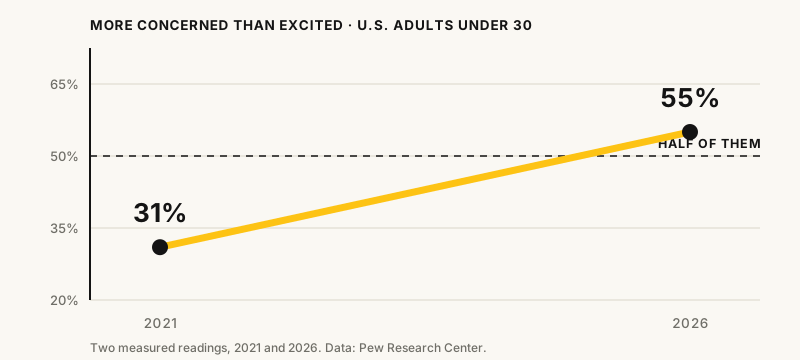
The line crossed 50% this year. Share of U.S. adults under 30 who say they are more concerned than excited about AI in daily life, 2021 through 2026. Chart: AI in Marketing Weekly · Data: Pew Research Center
On Thursday, Pew Research Center's Data Labs team published an audit called “How Much of the Internet Is Written With AI?” Samuel Bestvater, Aaron Smith, Carson TerBush, Chris Baronavski and Janakee Chavda pulled roughly 490,000 English-language webpages out of Common Crawl covering January 2021 through July 2026, then ran a detector called Open Pangram across a random 10,000-page sample of the July snapshot. Their finding: “Of all the pages in this sample, 10% show significant signs of AI authorship.” Narrow it to pages published after ChatGPT came out and the number climbs past a third. It splits by domain, too. Dot-com sits near 10%, dot-org at 4.6%, dot-edu and dot-gov both around 1%. The commercial web, the part you and I work on, is roughly ten times more machine-written than the university web.
There is one detail in that report I take personally. Pew compared writing style against a 2023 baseline and found em dashes showing up about twice as often, with Oxford commas up 63%. I have been telling students for two years that an em dash makes you sound like a robot. I would like the record to show that I was right.
Two days earlier, Colleen McClain and Eugenie Park published Pew's read on how people feel about all this. Fielded June 22 through 28 with 3,488 U.S. adults on the American Trends Panel. “Today, 52% of Americans say they are more concerned than excited about the increased use of AI in daily life,” up from 37% in 2021. Seventy-one percent expect AI to mean fewer U.S. jobs over the next twenty years, up from 64% in 2024. And for the first time, a majority of adults under 30, 55% of them, land on the concerned side. In 2021 that group was at 31%.
Then a third study, posted the same day as the survey. A team from Northeastern and Penn ran a preregistered field experiment on live Google Search with 1,100 participants. In their words, removing AI Overviews and AI Mode “increases click-through rates to publishers, while an AI Mode-only experience reduces click-through rates and erodes user experience and trust in information found on Google.” Two cautions before you quote that: it is a preprint, not peer reviewed, and the abstract gives direction rather than effect sizes. I can tell you which way it points, not how far.
Here is why I think these three belong in one story. Fewer clicks I already knew about. Less trust is the new part, and trust is not supposed to move in the same direction as convenience. Put it next to the authorship audit and you get a loop. The web fills with machine writing, readers get better at spotting it, their default posture shifts to suspicion, and the whole category of content gets cheaper to ignore. Your page is no longer being compared to your competitor's page. It is being compared to a pool where a third of everything new reads like nobody was home.
What it means Stop optimizing for polish and start optimizing for evidence that a person was involved. A real byline, a number with a link to the original, and one opinion you would defend out loud. Those are the three things a model tuned for agreeableness will not produce on its own, which is exactly why they read as human now.
10%of sampled pages show AI authorship
52%of Americans more concerned than excited
55%of adults under 30, a first majority
Paid Media
ChatGPT ads got a pixel, and that is the real news
OpenAI took ChatGPT Ads into 31 European markets, six months after starting U.S. tests. The geography is not the story. The toolkit is: conversion-optimization bidding on top of CPM and CPC, an OpenAI Pixel, a Conversions API, and third-party measurement. Ads run against the Free and Go tiers only. OpenAI says “tens of thousands of marketers have now advertised on ChatGPT,” and a self-service Ads Manager is still to come.
What it means This stopped being an awareness experiment and became a channel you can attribute. If you buy media in Europe, get a test in the Q4 plan and run it against a holdout, because OpenAI has published no reach or CPM benchmarks and the inventory is free-tier users by definition.
Policy & Pricing
The FTC is looking at your pricing page, not your pricing engine
On August 19 the Commission voted 2-0 to put out a proposed enforcement policy statement on personalized pricing, matter P034101, open for comment for 30 days after Federal Register publication. Chairman Ferguson: “When consumers see a listed price, they expect it to be same price that everyone else sees.” The statement's theory is deception under Section 5, and it concedes the agency cannot ban personalized pricing outright. Read the text and you notice something: it never says “artificial intelligence” or “algorithm.”
What it means The exposure is the gap between what your page implies and what your system does. If prices vary by person and the site reads like one price for everybody, close that gap now rather than after the comment window.
The visitor who converts · the optimization you can now detect · the parser that changed quietly
The Consumer
Fewer visitors, better visitors, and a catch worth reading twice
Adobe Digital Insights published its AI Traffic Trends report this month, built on more than a trillion visits to U.S. retail sites and over 100 million SKUs. Retail visitors arriving from an AI assistant converted at a rate 60% higher than everybody else, with revenue per visit up 53%, time on site up 59%, and bounce down 34%. AI-referred traffic in July ran 119% above last year for travel, 62% for retail, 31% for financial services. In Adobe's own survey of more than 5,000 people, 42% have used an AI assistant to shop and 83% of those say it improved the experience. Two caveats. Adobe sells the analytics, so read the enthusiasm accordingly. And the PDF carries no printed publication date, so I am dating it from Adobe's own file path.
What it means The trade is a smaller pipe carrying better-qualified people, which is a good trade. It is only a good trade if you are the thing being recommended. If you are not in the answer, that pipe does not narrow for you. It closes.
AI Search & Visibility
Somebody built a detector for GEO, and it works
Junjie Chu, Ye Leng, Mingjie Li, Yun Shen, Xinyue Shen and Yang Zhang at CISPA posted GEO-Flag on August 17, the first large-scale attempt to measure how much of what search returns has been optimized for generative engines. Running 1,000 real user queries and checking 10,095 retrieved pages, they estimate “an overall GEO prevalence of 8.90%, reaching 16.36% among pages modified in 2026.” Their classifier, trained to survive evasion attempts, moves aggregate F1 from 0.862 to 0.944 and worst-group accuracy from 0.725 to 0.883. Preprint, not yet peer reviewed.
What it means Every optimization technique that becomes measurable eventually becomes punishable. That has been the arc of SEO for twenty-five years and there is no reason GEO breaks the pattern. Write the page so it earns the citation on the merits, and treat any tactic that only works because nobody can see it as a rental, not an asset.
Technical & Measurement
Google changed how it reads your structured data and left it out of the changelog
What it means If your CMS escapes entities twice on the way into a JSON-LD block, and plenty do, rich results can stop working with no warning email. Run your top templates through the Rich Results Test this morning. Then remember today's other two changes before somebody reads a YouTube view spike or a Merchant Center shift as performance.
The Marketer's Playbook
What To Do Monday Morning
Four moves, in order, with dates attached. The first two are today.
1 · TodayRun your top ten page templates through Google's Rich Results Test. The JSON-LD escaping change is already live and it is not in the docs changelog, so nothing is going to tell you when your markup stops parsing.
2 · TodayPut a note in the reporting doc that Merchant Center reporting and YouTube view counting both change today. Anyone comparing this week to last week is comparing two different rulers.
3 · By FridayPick one flagship page and give it the three human tells: a named author with a face, every claim carrying a number and a link to the original, and one sentence with a real opinion in it. Then measure it against the polished version.
4 · Before October 1Audit your Microsoft Advertising campaign templates. New non-portfolio campaigns on Max Conversions, Max Conversion Value and Max Clicks lose the Max CPC field that day. Portfolio strategies, Target Impression Share, enhanced CPC and existing campaigns keep it.
What it means Two of these are plumbing and two are about being worth reading. In a week where the plumbing changed quietly and the audience got more skeptical, you need both.
Watch List & Sources
What I'm tracking into next week
01Conference Board Consumer Confidence, Tuesday, August 25. The Leading Economic Index ticked up in July, but consumer expectations stayed the drag on it. This is the read that tells you whether the 51.0 sentiment print was a mood or a trend. The Conference Board
02Michigan final August sentiment, Friday, August 28. The preliminary read was 51.0. If it holds through revision, the Q4 plan written in the spring is aimed at a buyer who no longer exists. Surveys of Consumers
03The FTC personalized-pricing comment window. It opens 30 days out from Federal Register publication, which had not happened as of this morning. If you price dynamically, this is a place to be heard rather than a place to be quiet. FTC
04Colorado's AI rulemaking docket, open through October 26. Draft rules on automated decision-making and conversational AI were filed August 11 and take effect in January. Still open to comment. Colorado Attorney General
05OpenAI's self-service Ads Manager. Promised for later in the summer. Until it lands, buying ChatGPT inventory runs through OpenAI's sales team or a partner, which is a real constraint on how fast anybody can test. OpenAI
Every claim above traces to a first-hand source. Links go to the original, not to coverage of it. Where a primary source was thin or missing, I say so in the item itself rather than at the bottom. Past issues live in the archive, and the daily show is on the podcast page.
Two sourcing notes I owe you. Google's JSON-LD change is documented only in a post from its own Search Central account, not in the docs. And Microsoft's October 1 Max CPC retirement has no Microsoft-hosted page behind it; the public statement comes from Navah Hopkins, Microsoft's own ads liaison, alongside an advertiser email sent August 20. Both are first-party voices. Neither is where you would go looking.
Pro Humanitate
A recurring close · The week, for humanity
Fifty-Five Percent
The number I keep coming back to is not the 52%. It's the 55%. For the first time, most American adults under thirty say they are more concerned about AI than excited by it. Five years ago that group sat at 31%. And 73% of them expect AI to mean fewer jobs.
I teach those people. They come into class on a Tuesday night after a full day of work, and a good number of them are studying the thing they are afraid of. That is a strange kind of courage, and I don't think anybody names it enough.
Here is what I have learned not to do. Don't talk them out of it. The worry is rational. They have watched entry-level work get automated in real time, and telling a 26-year-old that technology creates more jobs than it destroys is a macroeconomic claim that does nothing for the person sitting in front of you. It also sounds exactly like the machine writing in the Pew audit: fluent, agreeable, and unwilling to say anything that costs the speaker something.
What helps is smaller. Show them the part of the work a machine cannot do, then make them do that part until they are good at it. Deciding what is worth saying. Knowing when the data is lying. Sitting across from a client who is scared and telling them the truth anyway. None of that is on anybody's model roadmap, and all of it gets more valuable as the cheap stuff gets cheaper.
Wake Forest's motto is Pro Humanitate, for humanity. This week it looks like this. A tenth of the web is machine-written and climbing, more than half the country has moved from curious to wary, and the durable advantage left standing is being a person who is worth listening to. That's good news, if you are willing to do the work. It is also most of what we spend our time on in the digital marketing and AI program here at Wake Forest.
Human-centered AI in marketing. What actually shipped, and what to do about it Monday. Free, from Wake Forest University's School of Professional Studies.