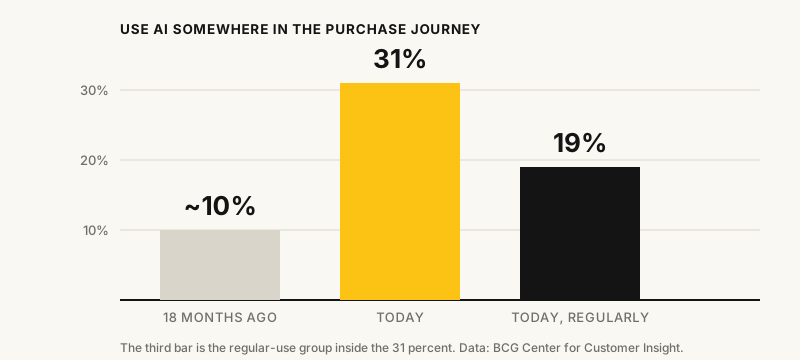
One in three shoppers now brings AI into the purchase. A year and a half ago it was one in ten.
BCG asked more than 13,000 people in twelve markets. Nineteen percent lean on AI regularly when they decide what to buy, and seven in ten of those buy what it hands them. In over half of AI-assisted journeys, the machine puts a brand in front of the shopper that she was not already considering.
Roughly a tripling in eighteen months. Share of surveyed consumers who use AI at some point in the purchase journey, with the regular-use group broken out. Chart: AI in Marketing Weekly · Data: BCG Center for Customer Insight
On Wednesday, BCG's Global Advantage practice and its Center for Customer Insight published a report called Global Consumers Have Moved On. Has Your Growth Strategy Caught Up? It runs on a survey of more than 13,000 consumers across twelve markets, over a hundred long-form interviews, and a read of more than a thousand brands. The number that will get quoted all fall: “Today, 31% of surveyed consumers use AI at some point in their purchase journey, roughly triple the level that did so just 18 months ago.” Nineteen percent are what BCG calls AI loyalists, people who reach for it every time, and 70% of that group buys what it recommends.
Here is the sentence I'd read twice. “In more than half of AI-assisted purchase journeys, the technology introduces consumers to brands they would not otherwise have considered.” Sit with that. The consideration set is being built by something that has never seen your media plan, never met your brand team, and does not care what you paid for the placement.
If that feels new, it shouldn't. It's a shelf problem in different clothes. Anybody who has fought for an endcap at Lowe's or a second facing at Walmart knows the feeling of somebody else deciding which five products the shopper gets to see. What's different is that you could call the buyer. You could bring data, bring a promotion, bring lunch. There is nobody to call here. The ranking gets assembled fresh, from whatever is legible about your product, every single time somebody types a question.
The trust data underneath it explains why this is moving so fast. More than half of the people BCG surveyed say they don't fully trust any single source of information. Four in ten say they feel buried by the sheer volume of it. AI already sits among their most trusted sources, next to experts and friends, and they expect that trust to climb another 15 points by 2030, faster than any other source in the study. People aren't using AI because it's clever. They're using it because they're tired.
Two cautions before you put this in a deck. It measures what people say they do, and stated behavior always runs ahead of the real thing. And BCG sells the strategy work that follows from the finding, so read the urgency accordingly. That said, the examples in the report are shipped products, not pilots: Instacart's Ask Instacart builds a cart out of a recipe, and Lowe's Mylow walks a customer through a project and picks the products. That last one is a forty-minute drive from my office.
What it means Your product data is your creative now. The attributes, the comparison points, the plain answer to “who is this for and who is it not for” — if that lives in a feed nobody has opened since 2023, you are invisible in the exact moment a shopper is deciding. Fix the feed before you fix the campaign.
31%use AI somewhere in the purchase journey
70%of AI loyalists buy what it recommends
+15ptsexpected gain in trust in AI by 2030
Brand & Agency Spotlight
ActiveCampaign bets that your own account beats the industry benchmark
On Thursday ActiveCampaign shipped Active Intelligence: Wavelength, and the pitch is a jab at the whole category. Their claim: 84% of marketers still run generic campaigns built on industry best practices instead of their own data. Wavelength reads one account — what you sent, what worked, who engaged, what changed on your site — and puts more than 500 signals behind each recommendation, then drafts the campaign and builds the segment. The company reports a 75% higher engagement rate for businesses on Active Intelligence and says early data shows click-through lifts as high as 17%. Vendor numbers, vendor math, no third-party audit. Read them as a claim, not a finding.
What it means The idea is right even if the numbers are generous. The industry benchmark was always a crutch for teams without enough of their own data. You have your own data. Pick one channel and rebuild its targeting off your account history instead of a category average, then see whether the benchmark was ever your friend.
The view count that moved · the holiday gap · the bill that comes due in skills
Measurement
Somebody finally priced YouTube's new view count
Last week I told you YouTube would start counting a view from the first frame on Monday and that anyone comparing this week to last week would be comparing two different rulers. Now there's a number on it. Agentio analyzed 35,800 creator videos from June and July and estimates public view counts on long-form will run roughly 30% above engaged views under the new method. The spread is not even: about 36.5% in technology and fitness, 27.0% in gaming, 32% for micro channels against 27% for the big ones. On 550 organic Shorts, which switched to first-frame counting last year, reported views ran 65% above engaged. One thing to hold onto: Agentio prices and reports its own creator inventory on engaged views, so it has a stake in which number the market treats as real.
What it means Reopen every creator rate card that renews in Q4 and reprice it against engaged views. A cost-per-view negotiated in July now buys about a third less attention, and nothing on the invoice will tell you.
The Consumer
Shoppers are ready for an AI holiday. Retailers say they are not.
Narvar's 2026 Holiday Shopping Report landed Monday, built on 1,348 U.S. consumers and 100 retail decision-makers. Sixty-five percent of shoppers plan to use AI for at least one part of holiday shopping. Eight percent of retailers describe themselves as very confident using AI to improve the shopping experience. The named uses are specific: 43% for gift discovery, 33% for comparing products and summarizing reviews, 29% for budgeting. Small retailer sample, and both sides are reporting intent rather than behavior, so treat the direction as the finding and the decimals as noise. The direction is a demand-side habit already running against a supply side still in pilot, eleven weeks out from Black Friday.
What it means Run Narvar's gap inside your own company this week. Ask analytics what share of July sessions arrived from an assistant. Ask merchandising whether product pages carry the attributes an assistant needs to answer a comparison question. Two questions, no purchase order.
The Profession
The ANA wants the industry to stop for a day and learn something
The Association of National Advertisers called on marketers to “Push Pause & Power Up” and put the work down for one day on September 17 for its Global Day of Learning. The program is aimed squarely at the future of marketing work: AI agents and custom GPTs, synthetic audiences, cross-media measurement, co-creation. Speakers from General Motors, Mastercard, LEGO, Duolingo and SAS. I like that the framing is about capability rather than procurement, because most of what I see going wrong with AI in marketing right now is not a software problem. It is a team that bought a tool and never changed a single step of how the work gets done.
What it means Put two people on the September 17 program and make the price of the ticket one changed process, written down, not a list of tools they liked.
The Marketer's Playbook
What To Do Monday Morning
Three moves with dates on them. The first one is today, and it costs nothing.
1 · TodayPull your top fifty product pages and ask one question of each: could a model answer “which of these should I buy, and why” using only what is on the page? Where it can't, you are missing an attribute, not a headline. BCG says more than half of AI-assisted journeys introduce a brand the shopper wasn't considering, and that introduction gets built out of structured facts.
2 · By FridayReprice every creator contract that renews in Q4 against engaged views rather than the public counter. Agentio's modeling puts the gap near 30%, ranging from 27% in gaming to 36.5% in technology and fitness, so do it by category and not with one blanket number.
3 · Before September 17Name the person on your team who owns metric definitions, and send two people to the ANA's Global Day of Learning. Between the BCG shift and the YouTube change, this is the quarter where somebody has to be accountable for what your numbers mean, and it should not be the agency that reports them.
The buyer you're selling to Conference Board confidence came in at 89.4 for August, the lowest since January, with expectations down 5.8 points to 68.2. Michigan's preliminary read was 51.0 and the final lands this morning. CPI is running 3.4% and consumers expect 4.3% over the year ahead. The shopper handing her decision to a machine is the most squeezed shopper in a decade, and that is a good part of why she is handing it over.
Watch List & Sources
What I'm tracking into next week
01Michigan final August sentiment, this morning. I flagged this last week. The preliminary was 51.0. If it holds, the Q4 plan most teams wrote in the spring is pointed at a buyer who no longer exists. Surveys of Consumers
02Whether any retailer names assistant-referred traffic in Q3 guidance. Narvar says 65% of shoppers plan to use AI this season. If that is real, somebody's earnings call has to mention it by November. Narvar coverage
03The rest of BCG's five shifts. AI is one of five themes in the report. The other four — value over price, longevity and well-being, solo living, and trust — are the ones nobody will quote, and solo households now run one in three in mature markets. BCG
04OpenAI's self-service Ads Manager. Still promised for “later this summer,” and summer is nearly gone. Until it lands, buying ChatGPT inventory runs through a salesperson or a partner, which caps how fast anyone can test. OpenAI
Every claim above traces to a first-hand source. Links go to the original where the original is reachable, and where I had to lean on coverage of a press release I say so in the item. Past issues live in the archive, and the daily show is on the podcast page.
Two sourcing notes I owe you. BCG's own publication page and the BLS release both block automated checks, so I read them by hand rather than by script. And Narvar's report and ActiveCampaign's launch are company press releases; I could not find an independent audit of either set of numbers, which is why both items say so in the text.
Pro Humanitate
A recurring close · The week, for humanity
Worth Recommending
The BCG number that stuck with me isn't the 31%. It's the four in ten who say they feel buried by how much information is coming at them. That is not a technology finding. That's exhaustion, and people are handing the decision to a machine because they are out of energy to make it themselves.
I've been in this business long enough to have helped cause it. We spent twenty-five years learning to make more: more pages, more variants, more retargeting, more touches. We got very good at it. Then we handed everybody a tool that makes it a thousand times faster and acted surprised when the audience put up their hands.
So here's the part I keep telling students. When a machine assembles the shortlist, the only durable move left is being the thing that deserves to be on it. Not the best-optimized. The best. That sounds soft until you try to do it on a Tuesday with a deadline, and then you find out it's the hardest work in marketing, because it means saying who your product is not for, publishing the comparison you'd rather bury, and putting a real name on the page.
Wake Forest's motto is Pro Humanitate, for humanity. This week it reads like this: the people you're selling to are tired, and they've hired a machine to filter you. You can spend the fall trying to game the filter. Or you can spend it becoming a brand that a tired person is glad the machine found. I know which one I'd rather teach, and it's most of what we do in the digital marketing and AI program here.
Human-centered AI in marketing. What actually shipped, and what to do about it Monday. Free, from Wake Forest University's School of Professional Studies.