OpenAI published its first ChatGPT ad results this morning. Read who measured them.
Three advertiser numbers, and each one is attributed to an outside company. All three of those companies appear on the fifteen-name measurement roster OpenAI announced in the same post. The numbers may well be right. They are also the vendor's homework, graded by the vendor.
What did OpenAI announce about ChatGPT ads on October 5, 2026?
Four things, in one post. A visual ad format that will be “tested during image generation in ChatGPT,” where OpenAI says ads “will be clearly labeled, and remain separate from the image being created.” A start date of “later this month in the US with an initial group of advertisers.” A measurement roster of fifteen named partners, plus brand-suitability pilots with DoubleVerify and Integral Ad Science. And a control called Negative Phrases, “now available to qualifying advertisers.” The reach claim is the one that will get quoted everywhere: “ChatGPT reaches 1.2 billion people each week, making it the world's largest AI-native consumer platform.”
I have been following this one since February. In the September 11 issue I wrote about Amazon selling ads inside ChatGPT, and in the September 25 issue about OpenAI putting a billion-dollar annual number on the business. So I came to this morning's post looking for the next beat in that story. I found something more boring and more useful.
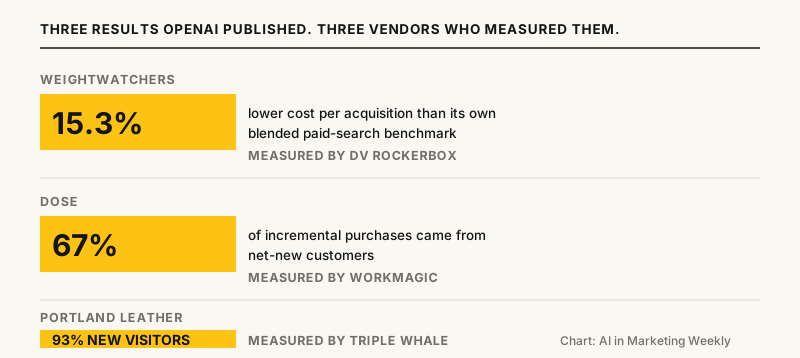
Start with the results, because they are the part people will screenshot. WeightWatchers: cost per acquisition 15.3% lower than its blended paid-search benchmark, “according to DV Rockerbox.” Dose: “WorkMagic reported statistically significant lift,” with 67% of incremental purchases from net-new customers. Portland Leather: “according to Triple Whale, 93% of Portland Leather's visitors from ChatGPT Ads were new.”
Now read the partner list in the same post. DV Rockerbox is on it. Triple Whale is on it. WorkMagic is on it twice, under attribution and again under incrementality. That is not a scandal and I do not want to write it as one, because this is genuinely how the ad industry has always done it. Google published Google numbers. Meta published Meta numbers. Somebody's pixel measured both. OpenAI skipped the part where it claims its own numbers and went straight to third-party attribution, which is the more credible move and also the harder one to check.
Every figure OpenAI published this morning carries an outside name on it. All three of those names also appear on the measurement roster announced in the same post. Chart: AI in Marketing Weekly
Who is on OpenAI's measurement roster?
It is worth reading in full, because the post sorts the names into tiers and the tiers tell you what OpenAI thinks it is building. On data: Hightouch, Tealium and LiveRamp. On attribution: AppsFlyer, Triple Whale, Adjust, DV Rockerbox, Northbeam, Branch, Singular, Kochava, Airbridge and Tenjin. On advanced measurement: Fospha, Measured and INCRMNTAL. On incrementality: Haus, Measured and WorkMagic. Brand suitability is separate and it is explicitly a pilot, “with DoubleVerify (DV) and Integral Ad Science (IAS).”
That data tier is the one I would stare at. Hightouch, Tealium and LiveRamp are how first-party customer data gets from a company's warehouse into an ad platform. Their presence on day one means this is not a brand-awareness placement, whatever the image-generation framing suggests. It is built to receive your customer list. If you have spent two years telling a client their first-party data is the asset that survives the end of third-party cookies, this is the week that argument gets tested somewhere new.
The brand-suitability line is the one I would push back on, gently. A pilot is not a product. DoubleVerify and Integral Ad Science are the two names a media buyer wants to hear, and naming them is the right instinct, but a pilot means the controls your agency normally insists on are not there yet for most advertisers. I would ask, out loud, in the first call: what exactly can I block today, and what can I only block once the pilot ends? Nobody will be offended by the question, and the answer is the difference between a test you can defend to a client and one you cannot.
The thing I would actually act on is the smallest item in the post. Negative Phrases. Strip the branding off that and it is a negative keyword list, the single most boring tool in paid search and the one that has saved more budget than any targeting feature ever shipped. Its arrival tells you where this platform is in its life. Six months ago ChatGPT ads were a placement. This morning they got exclusions and an attribution stack. That is an ad platform being assembled in public, in order, and the order is the same one every platform before it followed.
The image-generation placement deserves a second look too, and I am honestly not sure yet what I think of it. Somebody is in the middle of making a picture. That is a creative moment, not a shopping one, and it is the first time I can remember an ad showing up while a person is making something rather than reading something. OpenAI's own guardrail sentence is that ads “remain separate from the image being created,” which is the right call and the one I would have asked for. Whether a shopper in that moment is in any mood to buy is an open question, and the first wave of advertisers is about to answer it for free.
What it means Two things to do, and the first costs you twenty minutes. Write your Negative Phrases list now, before you are invited into the test, because you already own the raw material: pull the negative keyword list off your biggest paid search campaign and read it out loud. Most of it will transfer. Second, and this is the one nobody will do, decide in advance which of those fifteen attribution partners you would actually believe. You are going to be handed a number by a vendor in that chart, and the honest answer to “is this working” will depend entirely on whether you picked your measurement before you saw the result or after. Do not let a platform hand you both the ad and the grade. Pick the grader yourself, today, while you have no skin in the game.
1.2Bpeople OpenAI says ChatGPT reaches each week, “making it the world's largest AI-native consumer platform”
15measurement and attribution partners named in the post, including all three that supplied this morning's results
15.3%lower cost per acquisition for WeightWatchers than its blended paid-search benchmark, per DV Rockerbox
Policy That Lands On You
Three days earlier, the FTC sued a retailer over the price in its search ads
On Friday the FTC, joined by the Utah and Nevada Attorneys General, sued Lens.com. The complaint is about ad copy. The release says the company “prominently advertises eye-catching, artificially low prices in sponsored Google search ads,” then “hides the ‘Taxes & fees’ line item during the checkout process, hiding the line item below the viewable portion.” Those fees “routinely double the price it advertises for contact lenses, costing consumers hundreds of millions of dollars.” Christopher Mufarrige, who runs the FTC's Bureau of Consumer Protection, put it in one sentence: “Lens.com advertised one price for contact lenses but charged a substantially higher price at checkout, deceiving consumers.” The counts run under the FTC Act, ROSCA, the Gramm-Leach-Bliley Act and state law in both states.
One sourcing note, because I went looking. A multiple of “nearly 5x” is circulating in coverage of this case. It is not in the FTC's release, which says only that the fees often double the advertised price, so I am not repeating it.
The same agency, the same day, settled a price-discrimination case against Southern Glazer's, the largest wine and spirits distributor in the country. It is barred across 26 states from charging independent retailers materially higher prices than the big chains, under a six-year independent monitorship, with the violation threshold set at a differential above $5,000 over any twelve months. Robinson-Patman enforcement is awake again, which anybody who builds co-op or trade promotion programs should hear.
What it means Put Friday next to this morning and you have the week. One company is building a brand-new machine for making ad promises at scale. A federal agency spent the same week suing over a single promise that did not survive the walk to the checkout button. So go walk yours. On a phone, logged out, like a stranger. Does the number in the ad match the number above the button, and where exactly does the fee line appear? If you have to scroll to find it, you have the finding. That is not a legal exercise, it is twenty minutes and a thumb.
Anthropic put $100 million behind a job title that didn't exist
What is a Frontier Deployed Engineer?
As of , it is a credential. Anthropic announced $100 million to train 10,000 of them by the end of 2027 through the Frontier Deployed Engineer Residency, twelve weeks, out of San Francisco, New York and London, with graduates earning a Claude Frontier Deployed Engineer badge. Read the launch partner list and you will see who this is really for: Accenture, Bain, Capgemini, Commonwealth Bank of Australia, Deloitte, McKinsey, Morgan Stanley and Novo Nordisk. Steve Corfield, Anthropic's Global Head of Business Development and Partnerships, described the thesis plainly: “A small team of high-agency people with the right skills, access to Claude, and a deep understanding of how their business runs can transform an entire company.”
What it means I teach in this exact space, so let me say the uncomfortable part first. When a model company starts minting its own credential, it is competing with every university that teaches this material, mine included. I think that is fine, and I think it is good for the people getting trained. Here is the part that lands on your desk, though. Four of those eight launch partners sell strategy to your CMO. By next spring they will walk into that meeting with badged engineers and a methodology, and the pitch will not be about AI, it will be about how fast they can rebuild one of your processes. Worth deciding now whether your team wants to be the one being rebuilt or the one holding the pen. And notice the second half of Corfield's sentence, which is the half nobody will quote: “a deep understanding of how their business runs.” That part is not in the twelve weeks. That part is you.
Payrolls grew by 29,000 the Friday before the holiday opens
The Bureau of Labor Statistics put September nonfarm payrolls up 29,000, with the unemployment rate at 4.2%. Its own language for both is “changed little in September.” Average hourly earnings rose 5 cents to $37.81, up 0.1% for the month and 3.0% over the year. Retail trade employment showed “little change,” which is its own tell three days before the biggest October retail event of the year.
What it means A 3.0% annual raise is the number your customer is working from this week, and it has to cover a holiday. Nobody staffed up for this one, either. Put that next to a $37.81 average hourly wage and you can see what kind of promotion lands: the one that reads as help rather than as a treat. I would read the word “little” in that release three times, because a flat labor market going into a discount event is not a crisis, it is a shopper doing arithmetic.
The holiday season opened this morning, a day before anybody planned for
Walmart's own deals page carries the line “All the good stuff, 10/5 at 12am ET,” with a live countdown confirming it, and up to 50% off home, 40% fashion, 30% food and 30% toys. Target Circle 360 members got early access today as well, ahead of Deal Days on October 6 and 7. Amazon's Prime Big Deal Days runs those same two days across 22 countries and 35-plus categories, with deal drops at midnight, 8 a.m. and 1 p.m. Pacific and discounts Amazon puts at up to 55%. One honest note on dates: Walmart's page carries no publication date, so I can verify that the event starts today and not when the announcement went up. Amazon's and Target's releases are both from mid-September. The number to hold onto is Adobe's, from its September 28 forecast: $275.1 billion in US online sales from November 1 to December 31, up 6.7% year over year, with AI traffic to US retail sites forecast to rise 130%, built on Adobe Analytics data covering over 1 trillion visits, 100 million SKUs and 18 categories.
What it means Go look at where assistant and agent sessions are landing in your analytics before tomorrow morning, not after. If Adobe is anywhere close on that 130%, a meaningful slice of this week's traffic arrives with no referrer and gets booked as direct, and the first person to notice will be whoever has to explain why paid search “stopped working” in a Thursday meeting. Tag it today. Also, since Walmart moved first and Target matched, your competitive calendar is already a day stale. Check what your own promo clock says versus what the shelf next door is doing.
OpenAI printed the price list, and one model costs a hundredth of another
Also on Friday, OpenAI published a model guide for the GPT-6 family with the full price table. GPT-6 Astra lists at $10.00 input and $50.00 output. GPT-6.1 Sol at $2.00 and $10.00. GPT-6 Luna at $0.10 and $0.50. Cached input runs “up to 95% less” than uncached. One caveat I have to flag: the guide's table does not spell out its units in the text I could read, so treat those as per-million-token figures with that unconfirmed. The line worth pinning above a desk comes from Eric Provencher on OpenAI's developer experience team: “Models have gotten much better at understanding nuance and ambiguity, so overly specific guidance can now hinder results.”
What it means Luna to Astra is a hundredfold difference on input. If your team runs one model for everything, and most teams do because somebody picked it in a hurry last year, that is the biggest unexamined line in your AI budget. Sort your use cases into two buckets this week, the ones where a wrong answer costs a client and the ones where it costs a reread, and price them differently. Then read the Provencher quote to whoever writes your prompts. A lot of the prompt scaffolding we all built in 2025 is now making output worse, and nobody has gone back to delete it.
Google published a way to prove a privacy claim instead of making one
Katharine Daly and Daniel Ramage of Google Research described a federated learning system built on Trusted Execution Environments, where the privacy guarantee is externally verifiable and the data-access policies running on a device get published to a public transparency log. Their reported results are “stronger privacy guarantees and/or smaller noise multipliers” and “significantly faster compute times than our previous FL system,” from training an English next-word prediction model for 5,000 rounds with cohorts of 6,500 devices. Two pieces are open source, Confidential Federated Compute and Federated Language. Being straight with you: the blog post gives no privacy budget values and no accuracy deltas, and the arXiv paper behind it is where those would live, so I am reporting the design and not a benchmark.
What it means This is not a marketing product and it will not touch your stack this quarter. It matters because of the shape of it. A transparency log that an outsider can read is a different kind of promise than a privacy policy that says trust us, and once one platform ships verifiable, every procurement questionnaire you fill out in 2027 starts asking for it. Think about the last time a client asked where their customer data actually went and you answered with a paragraph. The answer is becoming a log file. Start getting comfortable with that, because the first vendor in your category who can show one is going to win a deal with it.
Three moves. The first one takes a phone and twenty minutes.
1 · MondayWalk your own ad-to-checkout path on a phone, logged out. Does the price in the ad match the price above the button, and do you have to scroll to find the fees? The FTC sued Lens.com on Friday for hiding that line below the viewable portion. If you scroll, that's the finding.
2 · Before TuesdayWalmart opened Fall Deals today and Prime Big Deal Days runs October 6 and 7. Tag assistant and agent sessions in analytics before the traffic arrives, because Adobe forecasts AI traffic to US retail sites up 130% this holiday and untagged agent visits book as direct.
3 · This weekPull the negative keyword list off your biggest paid search campaign. That's your ChatGPT Negative Phrases list, ready before the test invitation arrives. Then pick which of OpenAI's fifteen attribution partners you'd actually believe, while you still have no result riding on the answer.
The thread running through all of it Last week the thread was identity, whose name is on the login. This week it is simpler and older: price. What the ad says the price is. What the price turns out to be at the button. What the distributor charges the independent shop versus the chain. What a token costs when you run a hundred million of them. What an hour of work pays now, which is $37.81 on average and 3.0% more than a year ago. Every story in this issue is somebody putting a number in front of a person and that person deciding whether to believe it. I don't think the AI part changes the ethics of that at all. It changes the volume. One ad with a misleading price is a bad decision somebody made on a Tuesday; a system that can generate ten thousand of them is a bad decision somebody made once, at scale, and then went to lunch. So the discipline that is about to matter is not creative and it is not media. It's whether anybody on your team still checks that the number in the ad is the number on the receipt.
Watch List & Sources
What I'm tracking into next week
01Prime Big Deal Days results, Wednesday and Thursday. Day-one reads land fast, and this is the first big event where the agent-traffic question has a real number attached rather than a forecast. Watch whether anybody reports assistant-driven sessions separately, because that is the measurement gap this whole quarter turns on. Amazon
02The actual start date of the ChatGPT image-generation ad test. OpenAI says “later this month in the US with an initial group of advertisers” and names no date and no advertisers. Who gets in first will tell you what category OpenAI thinks this placement is for. OpenAI
03Whether OpenAI ever publishes a number of its own. Every figure in this morning's post belongs to a partner. At some point a platform has to put its own measurement on the table and let somebody audit it, and the week that happens is the week this becomes a real ad business rather than a promising one. OpenAI
04IAB's Measurement Services Addendum, comment closes October 22. Standardized contract terms for measurement, verification and attribution, out for public comment since September 22. Read it against the fifteen-partner roster above and you will see why the timing is not a coincidence. If your contracts with measurement vendors were written by whoever was available, this is the free upgrade. IAB
05The Lens.com docket. The complaint was filed Friday and the question that matters to everybody else is how broadly the FTC reads “prominently advertises” when the price sits in a sponsored search ad. A ruling here is a rule for every retailer running shopping ads. FTC
06Advertising Week New York, today through Thursday. Four days of vendor announcements starting the same morning OpenAI shipped an ad format, which is either coincidence or very good calendar work. Expect the measurement conversation above to be the hallway topic. Advertising Week
07Connecticut Public Act 26-64, which I still have not been able to read. It took effect October 1 and lawyers describe it as expanding the state's privacy act with a data-broker registry and new rules on geolocation sales and surveillance pricing. The state's own PDF would not render for me, so I am not reporting a single provision from it until I can read the text myself. Flagging it here because it is live and it is on me to finish. Connecticut General Assembly
Every claim above traces to a primary source, and each story carries its own sources rather than pooling them. Where a figure is a company's own number, the copy says so. Where a date or a unit could not be confirmed at the primary source, the copy says that too, and one item in the watch list is here precisely because I could not read its source yet. Past issues live in the AI in Marketing Weekly archive, the show is on the AI in Marketing Daily podcast page, and the reader questions I get most often are answered in the FAQ.
My father could read a price tag and know whether he was being treated fairly.
That sounds quaint and it isn't. It's the oldest contract in commerce. A number on a tag, a number at the register, and a person who can compare the two in about a second. Every market we have ever built sits on top of that one small act of verification, and it works because it costs the shopper almost nothing to perform.
What the FTC described on Friday is that act being quietly defeated. Not by fraud exactly, and not by anything a jury would need a whiteboard to follow. By scrolling. The fee line exists, it is honest, it is right there in the cart, and it sits below the viewable portion of the screen. Somebody made a design decision about where a number goes, and that decision was worth hundreds of millions of dollars according to the government's own estimate.
I keep thinking about how small that is. Nobody lied. A thing moved down.
And then this morning a company with 1.2 billion weekly users announced it will start putting ads inside the moment a person is making a picture, with fifteen measurement partners and a brand-new exclusions list. I am not drawing a line between those two stories as though one caused the other, because that would be cheap and it wouldn't be true. What I am saying is that the second one makes the first one cheaper to do. When you can generate a thousand versions of a promise, the version where the number sits a little lower on the page will show up in the test, and it will win, and no person will have decided anything.
Pro Humanitate is Wake Forest's motto and it means for humanity. I use this space to treat it as a test rather than a sentiment, and the test this week is almost embarrassingly concrete. Pick up your phone. Open your own ad. Buy your own thing. See whether the number you promised is the number you charged, and see how far your thumb had to travel to find out.
If it took you more than a second, you already know what to do, and you don't need a framework for it. That instinct, the one my dad had in a hardware store, is the whole job. It is also, more or less, what we spend a term arguing about in the Master of Digital Marketing and AI at Wake Forest. Build the machine, then go stand where the customer stands.
Human-centered AI in marketing. What actually shipped, and what to do about it Monday. Free, from Wake Forest University's School of Professional Studies.